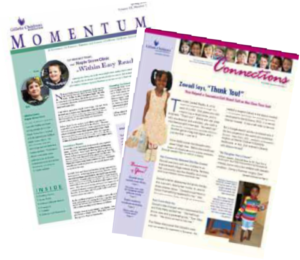
Let me tell you about one of my favorite turnaround stories. Not because it was particularly complicated—quite the opposite. But because it perfectly illustrates how nonprofits can spend 20 years doing the same thing wrong and never question it.
The Trainwreck I Inherited
When I landed at a Midwestern children’s hospital, their quarterly donor newsletter was hemorrhaging money to the tune of nearly $40,000 a year. That’s not a typo. They were mailing 20,000 pieces four times a year and losing money on it.
A 2004 readership survey yielded a whopping 91 responses. From 20,000 people. Math wasn’t my best subject, but even I could see that wasn’t working.
The Problem That Wasn’t Really a Problem
Here’s the thing: newsletters aren’t inherently bad. Expensive? Sure. Time-consuming? Absolutely. But the real issue wasn’t the format—it was the fundamental misunderstanding of who this thing was actually for.
After reviewing 20 years of content, the problem smacked me in the face: We were telling the stories that made our organization look important—not the stories that made our donors feel important.
We helped children walk. We opened new clinics. We conducted successful fundraising programs. We did amazing things!
And every single one of those incredible accomplishments left readers with the same nagging question: “If you’re doing so great, why do you need me?”
Yeah. That’s a problem.
What Donors Actually Want (Spoiler: It’s Not About You)
After more than a year of negotiation with internal stakeholders (even though the old version was a total money pit, staff and leadership loved it. After all, it won them lots of communications awards), we finally scrapped the old newsletter and created a newsletter that spoke to our (donor) audience like they mattered. Revolutionary concept, I know.
Turns out donors want to hear three incredibly simple things:
You matter. Not “we matter.” Not “look what we did.” But “look what YOU made possible.” We reframed every accomplishment as their accomplishment. Headlines like “Because of You, Douglas Can Visit an Imaging Center Without Crying!” instead of “We Open New Imaging Center.”
You have invested wisely. Nobody wants to back a loser. We got transparent about our financial health and future plans. We proved their money was working.
We still need you! Even in success stories, we left them wanting more. We shared new needs, opportunities, and goals. We made it clear that the relationship wasn’t over—it was just beginning.
Questioning Stupid Assumptions
Here’s where it gets fun. Everyone “knows” that a cost-effective newsletter must be an unsegmented self-mailer printed in one or two colors, right?
Wrong.
Our old newsletter was exactly that: 8 pages, 11×17, black plus one color, reply envelope stapled inside, mailed at nonprofit bulk rate. It cost $15,000 per issue to reach 20,000 people.
Using the same budget, we made changes that actually made sense:
Format: Cut it from eight 11×17 pages to four 8.5×11 pages. Slashed word counts by more than 50%. Lead story went from 1,200 bloated words to a tight 500. People don’t read War and Peace—they skim. We made it skimmable. We also converted it to four-color.
Personalization: Added a personalized cover letter and reply device that corresponded to each donor’s past giving behavior. Now we could segment mailings for better delivery and measurement.
Envelope and Stamp: Ditched the self-mailer for a standard No. 10 envelope with a live stamp. Yes, it cost marginally more in postage. But it looked like mail people actually open instead of junk they throw away.
The Results (AKA: Vindication)
The old newsletter generated a net loss of $39,549 in a single year.
The first four issues of our new version of the newsletter generated a positive net return of $56,705.
That’s a swing of nearly $100,000. Same budget. Different approach.
The new newsletter is building lasting relationships with donors and inspiring them to invest more of their charitable gifts with us. Which means we can provide care for even more kids across the country.
In total, the newsletter program achieved a 1,000% increase in revenue after a full year of these changes were implemented.
The Moral of the Story
Stop telling stories that make you look important. Start telling stories that make your donors feel essential.
Newsletters don’t have to suck. But they can’t improve unless you’re willing to change.
And for the love of all that’s holy, if something has been losing money for 20 years, maybe—just maybe—it’s time to question whether you’re doing it right.
If you want to improve your nonprofit newsletter performance, check out my Annual Giving Blueprint. It includes my Nonprofit Newsletter Optimization Guide (the exact framework I used to improve this children’s hospital newsletter), and dozens of other value-packed resources!